Colloquium d’Informatique de Sorbonne Université
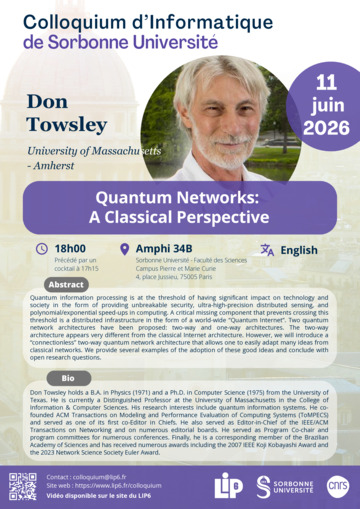
Don Towsley, University of Massachusetts - Amherst
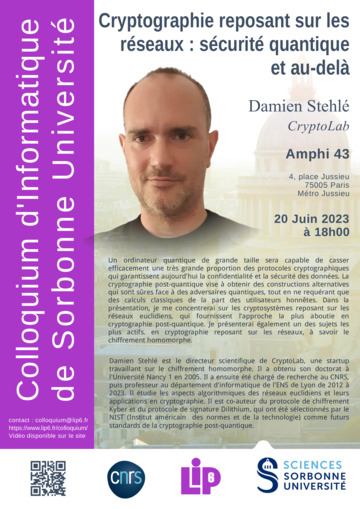
Quantum Networks: A Classical Perspective
Don Towsley holds a B.A. in Physics (1971) and a Ph.D. in Computer Science (1975) from University of Texas. He is currently a Distinguished Professor at the University of Massachusetts in the College of Information & Computer Sciences. His research interests include quantum information systems. He co-founded ACM Transactions on Modeling and Performance Evaluation of Computing Systems (ToMPECS) and served as one of its first co-Editor in Chiefs. He served as Editor-in-Chief of the IEEE/ACM Transactions on Networking and on numerous editorial boards. He served as Program Co-chair and program committees for numerous conferences. He is a corresponding member of the Brazilian Academy of Sciences and has received numerous awards including the 2007 IEEE Koji Kobayashi Award and the 2023 Network Science Society Euler Award. He has received numerous best paper awards including the IEEE Communications Society 1998 William Bennett Paper Award.
Quantum information processing is at the threshold of having significant impact on technology and society in the form of providing unbreakable security, ultra-high-precision distributed sensing, and polynomial/exponential speed-ups in computing. Many of these applications are enabled by high rate distributed shared entanglement between pairs and groups of users. A critical missing component that prevents crossing this threshold is a distributed infrastructure in the form of a world-wide “Quantum Internet”. Two quantum network architectures have been proposed: two-way and one-way architectures. A two-way network generates and distributes quantum entanglement to pairs or groups of users whereas a one-way network allows for direct transfer of quantum information from one user to another. We compare these architectures and conclude that a two-way architecture is superior. The two-way architecture appears very different from the classical Internet architecture. However, we will introduce a “connectionless” two-way quantum network architecture that allows one to easily adapt many ideas from classical networks. We provide several examples of the adoption of good ideas and conclude with open research questions.
À propos
Initié en 2012, le Colloquium d’Informatique de Sorbonne Université est un évènement régulier ayant pour but d’inviter des personnalités majeures du domaine de l’informatique à donner une conférence sur le campus de la faculté des sciences et ingénierie de Sorbonne Université. Il vise un public large, divers mais techniquement averti, et notamment les chercheurs en informatique de toutes spécialités, les doctorants et les étudiants en informatique de niveau Master.
L’évènement principal du Colloquium est l’exposé de l’orateur, d’environ 45 minutes, suivi d’une séance de questions et d’interactions avec l’auditoire. Il est généralement associé à l’organisation d’une masterclass à destination des doctorants du LIP6 et/ou d’autres laboratoires.
Principal participant au comité d’organisation, le LIP6 assure l’organisation du Colloquium et reçoit occasionnellement le soutien de l’ISIR.
Comité de Pilotage
Contact: Antoine Miné
Annonce des Colloquium
Si vous ne souhaitez plus être informé des événements, vous pouvez vous désinscrire de la liste de diffusion
- Année 2025 – 2026
-
Don Towsley
11 juin 2026
Quantum Networks: A Classical Perspective -
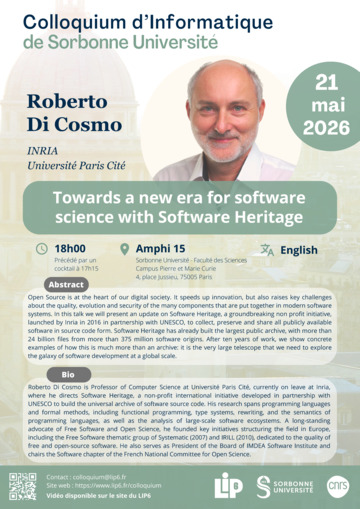 Roberto Di Cosmo
21 mai 2026
Towards a new era for Software Science with Software Heritage -
 Christine Azevedo
20 janvier 2026
Restaurer des fonctions de membres paralysés par stimulation électrique -
 Joseph Halpern
11 décembre 2025
Actual Causality: A Survey -
 Véronique Cortier
26 novembre 2025
Vote électronique : conception, attaques et vérification formelle
-
- Année 2024 – 2025
-
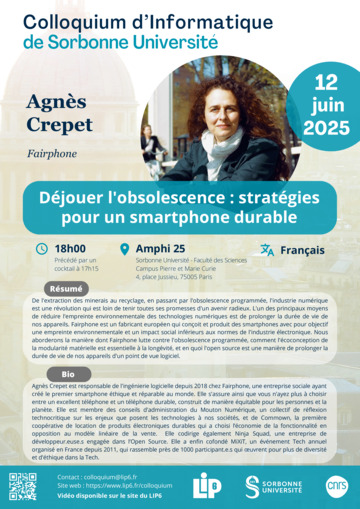 Agnès Crepet
12 juin 2025
Déjouer l'obsolescence : stratégies pour un smartphone durable -
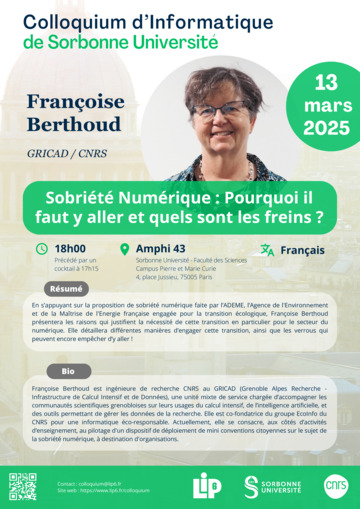 Françoise Berthoud
13 mars 2025
Sobriété Numérique : Pourquoi il faut y aller et quels sont les freins ? -
 Sandrine Blazy
26 novembre 2024
Compilation vérifiée : vers du logiciel zéro défaut -
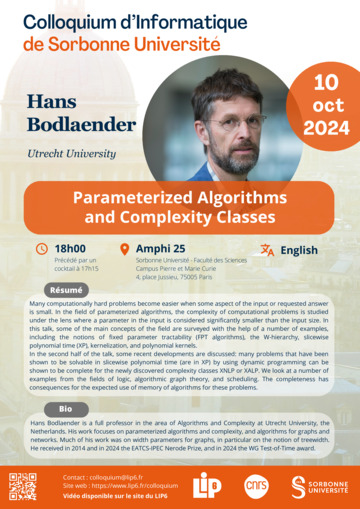 Hans Bodlaender
10 octobre 2024
Parameterized Algorithms and Complexity Classes
-
- Année 2023 – 2024
-
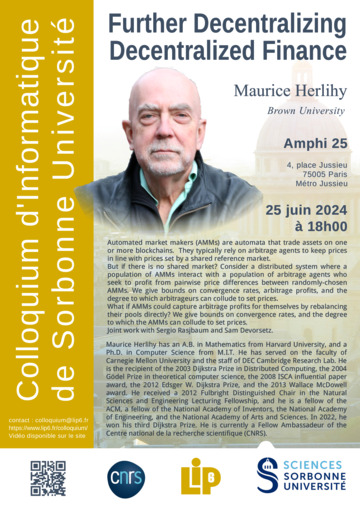 Maurice Herlihy
25 juin 2024
Further Decentralizing Decentralized Finance -
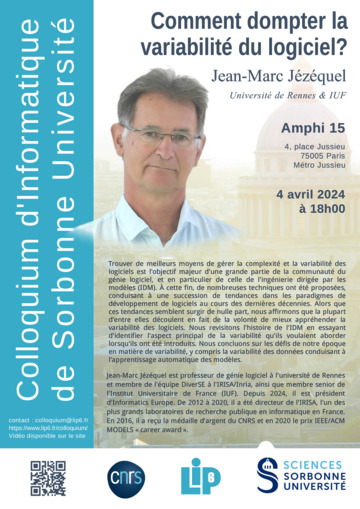 Jean-Marc Jézéquel
04 avril 2024
Comment dompter la variabilité du logiciel ? -
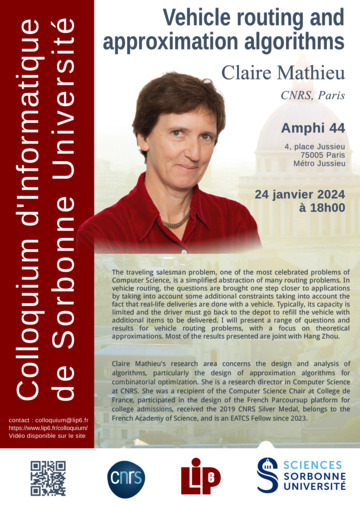 Claire Mathieu
24 janvier 2024
Vehicle routing and approximation algorithms -
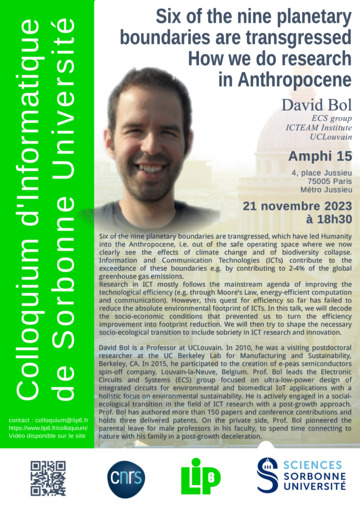 David Bol
21 novembre 2023
Six of the nine planetary boundaries are transgressed – How we do research in the Anthropocene?
-
- Année 2022 – 2023
- Année 2021 – 2022
- Année 2020 – 2021
- Année 2019 – 2020
- Année 2018 – 2019
-
 Cláudio T. Silva
11 juin 2019
Urban Data Science -
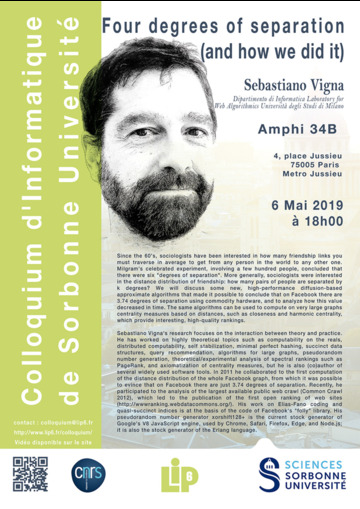 Sébastiano Vigna
06 mai 2019
Four degrees of separation (and how we did it) -
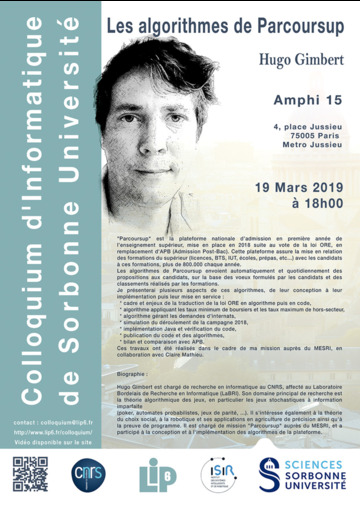 Hugo Gimbert
19 mars 2019
Les algorithmes de Parcoursup -
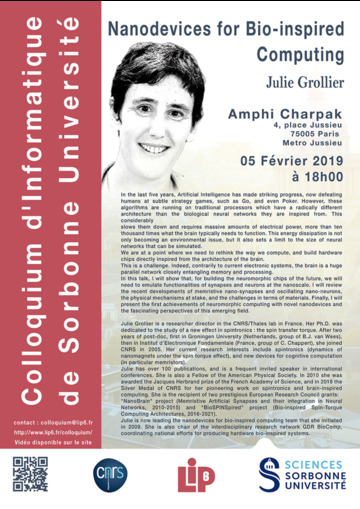 Julie Grollier
05 février 2019
Nanodevices for Bio-inspired Computing -
 Jacques Pitrat
20 novembre 2018
L'IA forte -
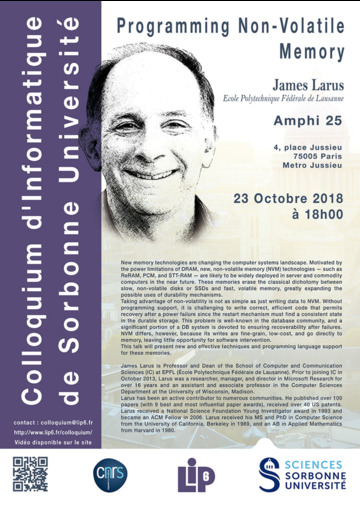 James Larus
23 octobre 2018
Programming Non-Volatile Memory
-
- Année 2017 – 2018
-
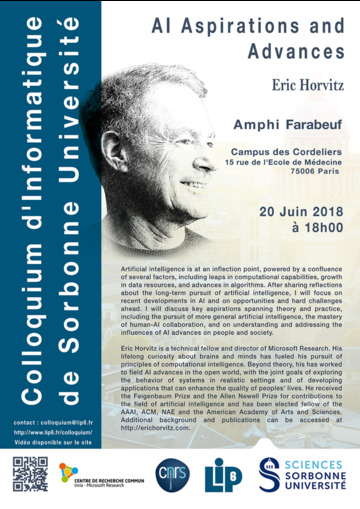 Eric Horvitz
20 juin 2018
AI Aspirations and Advances -
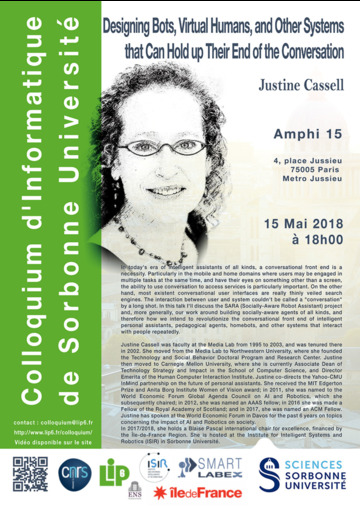 Justine Cassell
15 mai 2018
Designing Bots, Virtual Humans, and Other Systems that Can Hold up Their End of the Conversation -
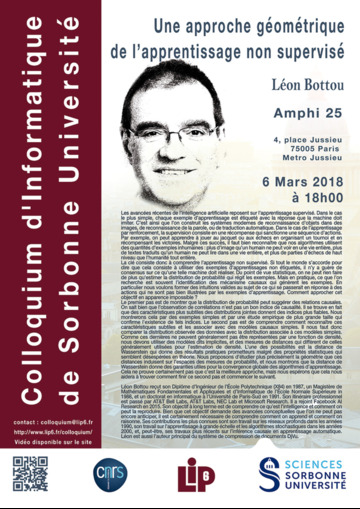 Léon Bottou
06 mars 2018
Une approche géométrique de l'apprentissage non supervisé -
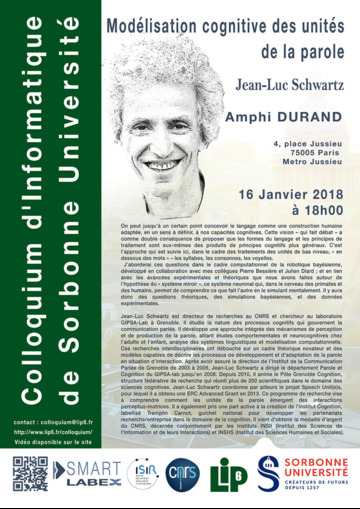 Jean-Luc Schwartz
16 janvier 2018
Modélisation cognitive des unités de la parole -
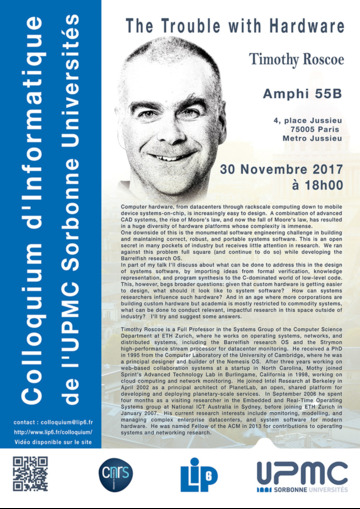 Timothy Roscoe
30 novembre 2017
The Trouble with Hardware
-
- Année 2016 – 2017
-
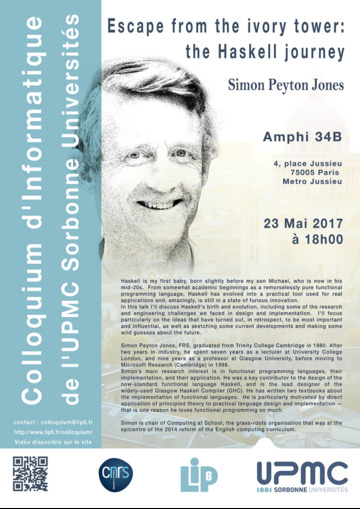 Simon Peyton Jones
23 mai 2017
Escape from the ivory tower: the Haskell journey -
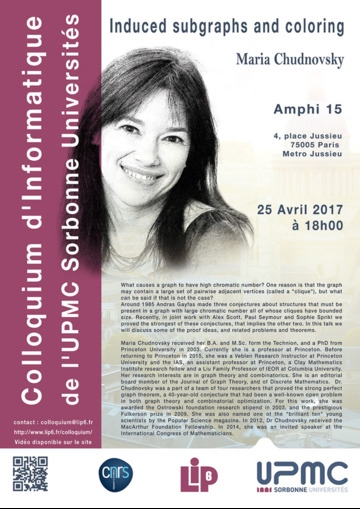 Maria Chudnovsky
25 avril 2017
Induced subgraphs and coloring -
 Philippa Gardner
28 mars 2017
Understanding and Verifying JavaScript Programs -
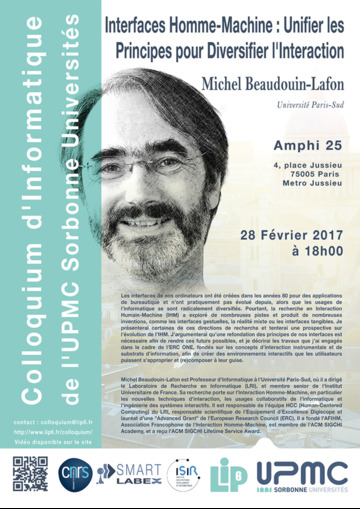 Michel Beaudoin-Lafon
28 février 2017
Interfaces Homme-Machine -
 Marie-Paule Cani
22 novembre 2016
Modélisation 3D expressive -
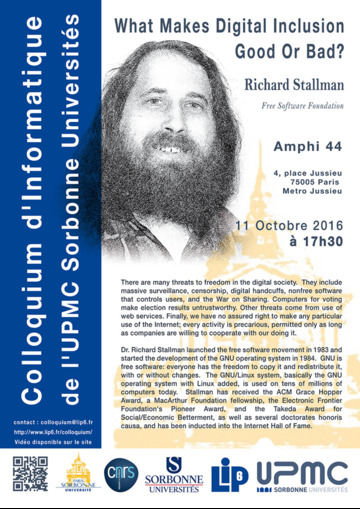 Richard Stallman
11 octobre 2016
What Makes Digital Inclusion Good Or Bad? -
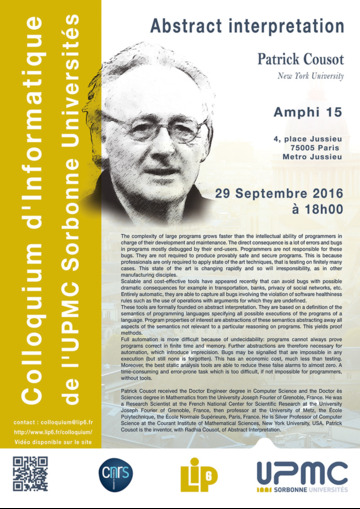 Patrick Cousot
29 septembre 2016
Abstract interpretation
-
- Année 2015 – 2016
-
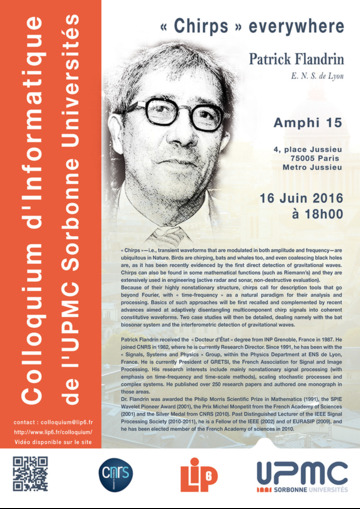 Patrick Flandrin
16 juin 2016
« Chirps » everywhere -
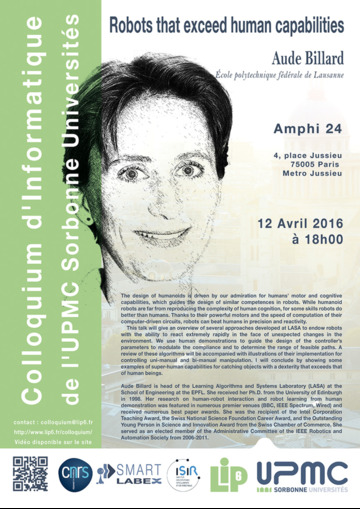 Aude Billard
12 avril 2016
Robots that exceed human capabilities -
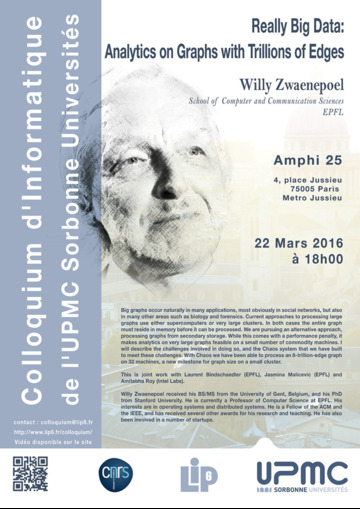 Willy Zwaenepoel
22 mars 2016
Really Big Data -
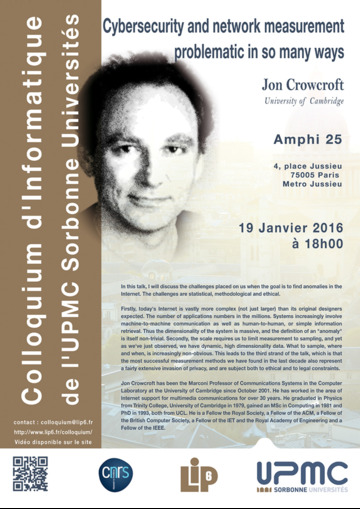 Jon Crowcroft
19 janvier 2016
Cybersecurity and network measurement -
 Isabelle Collet
24 novembre 2015
Les informaticiennes, de la dominance de classe aux discriminations de sexe -
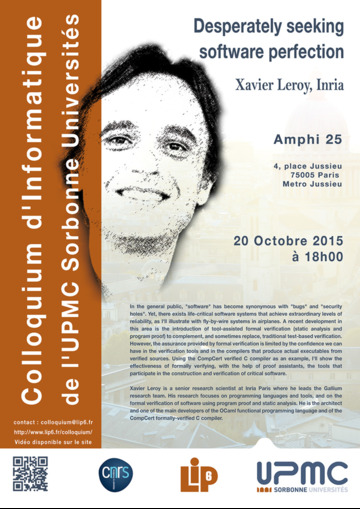 Xavier Leroy
20 octobre 2015
Desperately seeking software perfection
-
- Année 2014 – 2015
-
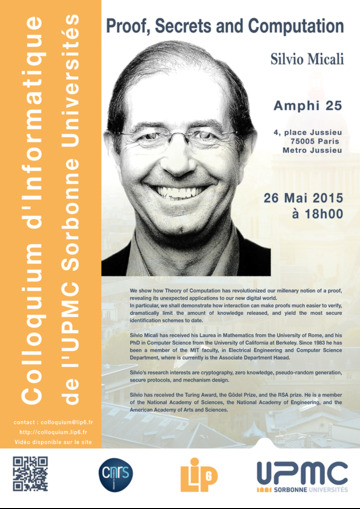 Silvio Micali
26 mai 2015
Proofs, Secrets, and Computation -
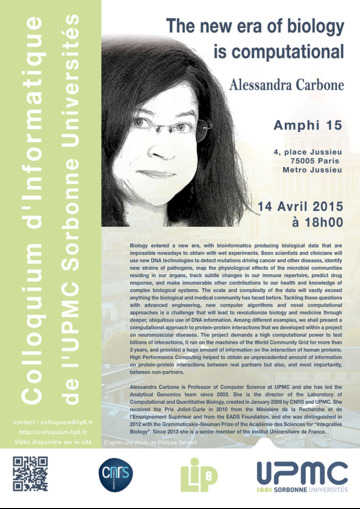 Alessandra Carbone
14 avril 2015
The new era of biology is computational -
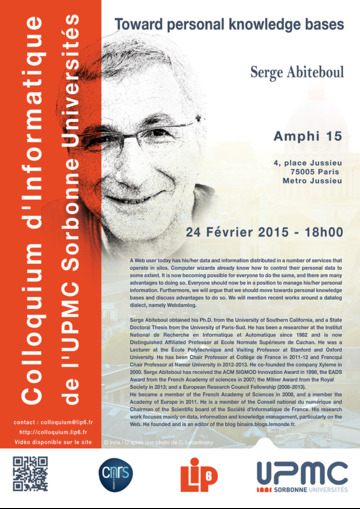 Serge Abiteboul
24 février 2015
Toward personal knowledge bases -
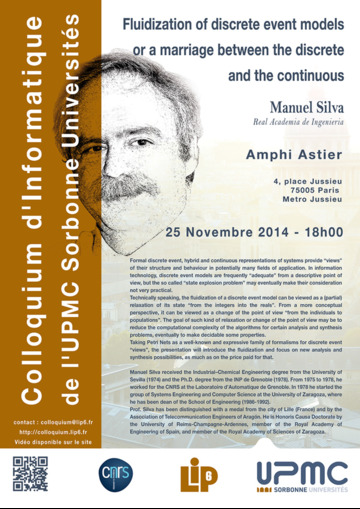 Manuel Silva
25 novembre 2014
Fluidization of discrete event models or a marriage between the discrete and the continuous -
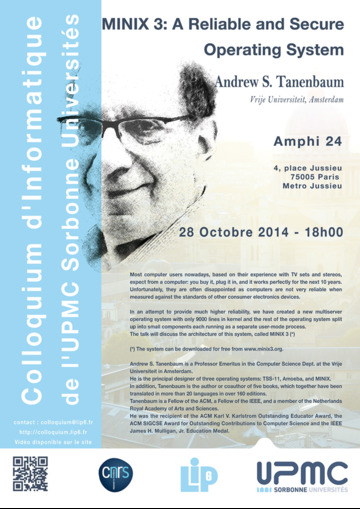 Andrew S. Tanenbaum
28 octobre 2014
MINIX 3: A Reliable and Secure Operating System
-
- Année 2013 – 2014
-
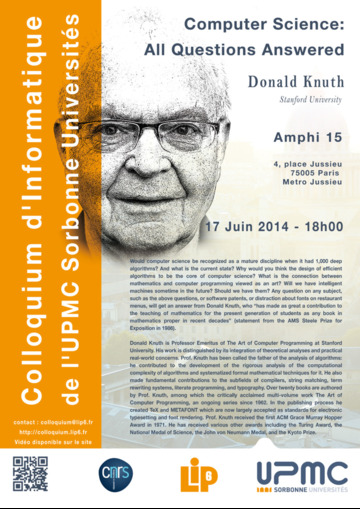 Donald Knuth
17 juin 2014
Computer Science: All Questions Answered -
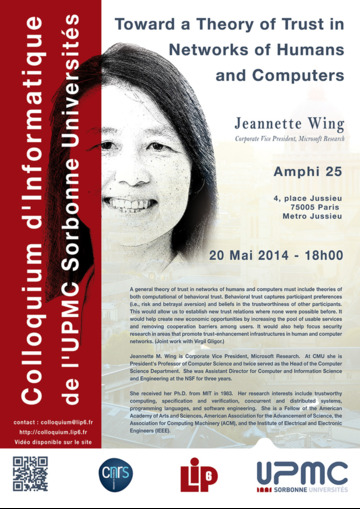 Jeannette Wing
20 mai 2014
Toward a Theory of Trust in Networks of Humans and Computers -
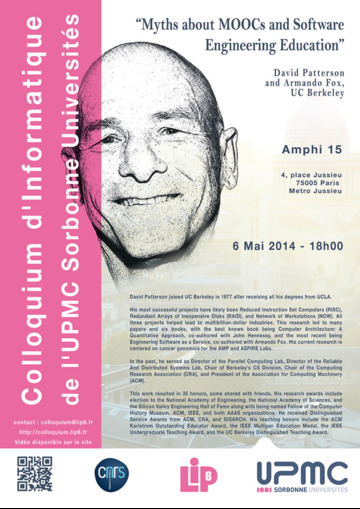 David Patterson
06 mai 2014
Myths about MOOCs and Software Engineering Education -
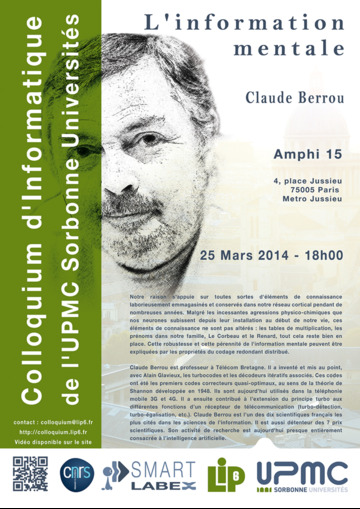 Claude Berrou
25 mars 2014
L'information mentale -
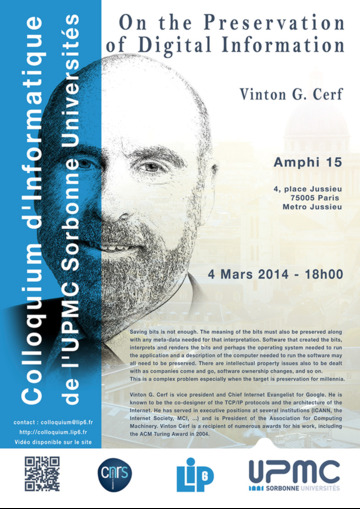 Vint Cerf
04 mars 2014
On the Preservation of Digital Information -
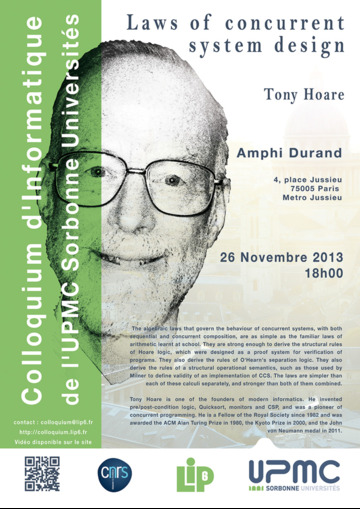 C.A.R. (Tony) Hoare
26 novembre 2013
Laws of concurrent system design -
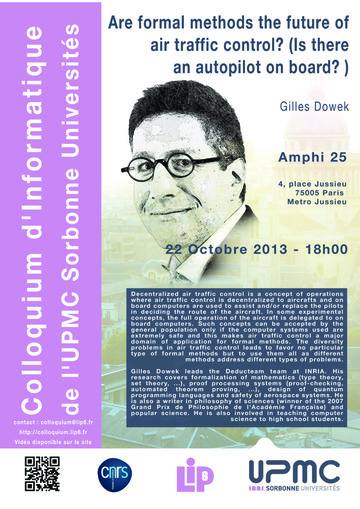 Gilles Dowek
22 octobre 2013
Are formal methods the future of air traffic control?
(Is there an autopilot on board?)
-
- Année 2012 – 2013
-
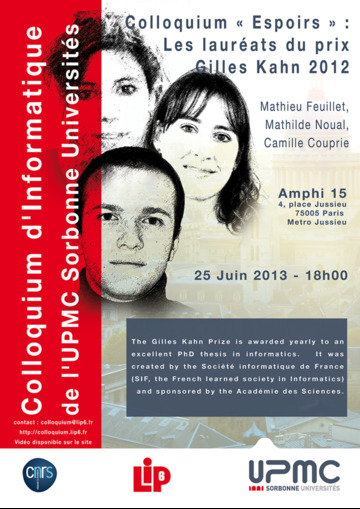 Mathieu Feuillet, Camille Couprie, Mathilde Noual
25 juin 2013
Espoirs : Winners of the 2012 Gilles Kahn prize -
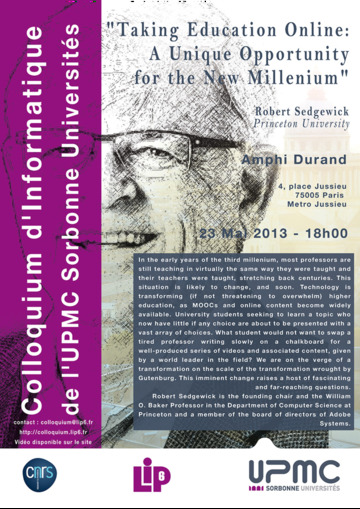 Robert Sedgwick
23 mai 2013
Taking Education Online: A Unique Opportunity for the New Millenium -
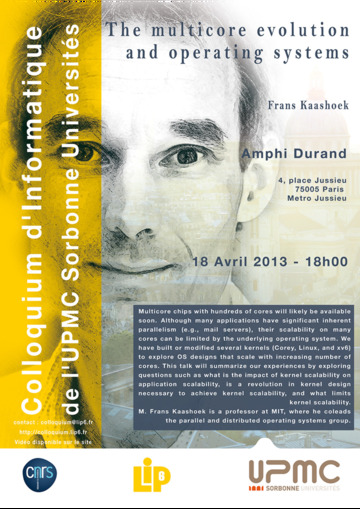 Frans Kaashoek
18 avril 2013
The multicore evolution and operating systems -
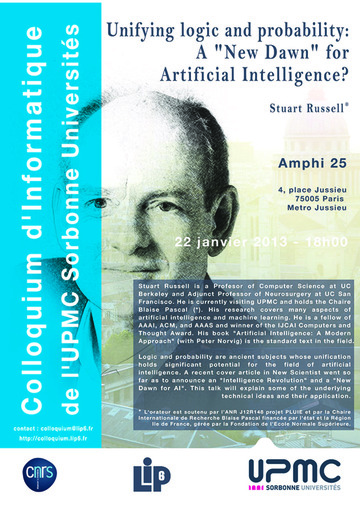 Stuart Russell
22 janvier 2013
Unifying logic and probability: A “New Dawn” for Artificial Intelligence? -
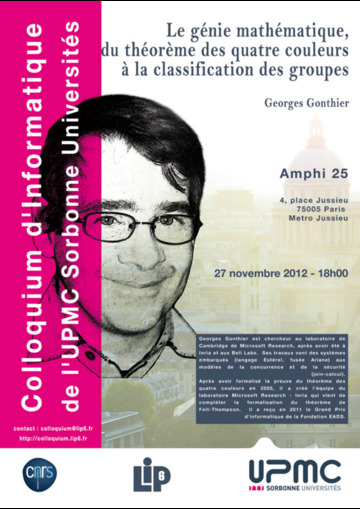 Georges Gonthier
27 novembre 2012
Le génie mathématique, du théorème des quatre couleurs à la classification des groupes -
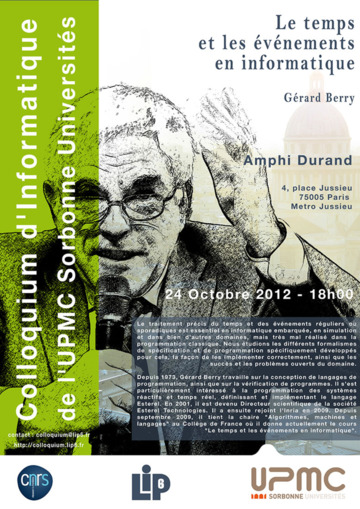 Gérard Berry
24 octobre 2012
Le temps et les événements en informatique
-
- Année 2011 – 2012