Colloquium d’Informatique de Sorbonne Université
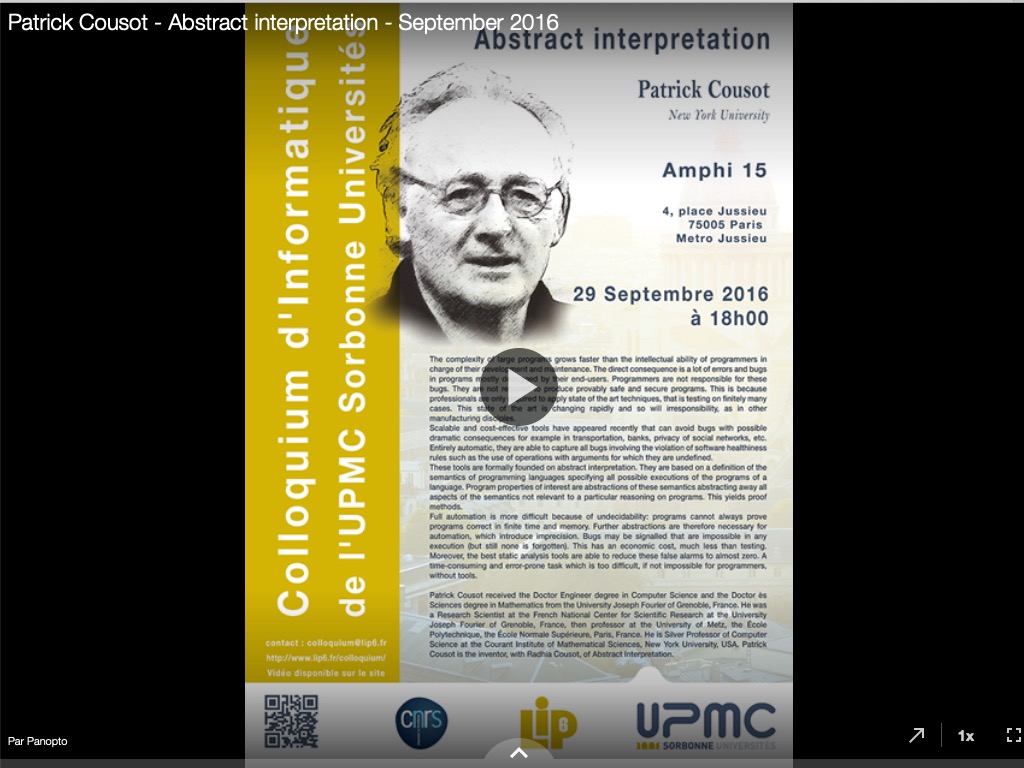
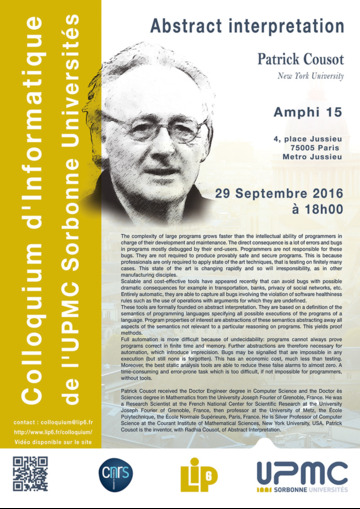
Patrick Cousot, New York University
Abstract interpretation
Patrick Cousot received the Doctor Engineer degree in Computer Science and the Doctor ès Sciences degree in Mathematics from the University Joseph Fourier of Grenoble, France. He was a Research Scientist at the French National Center for Scientific Research at the University Joseph Fourier of Grenoble, France, then professor at the University of Metz, the École Polytechnique, the École Normale Supérieure, Paris, France. He is Silver Professor of Computer Science at the Courant Institute of Mathematical Sciences, New York University, USA. Patrick Cousot is the inventor, with Radhia Cousot, of Abstract Interpretation.
The complexity of large programs grows faster than the intellectual ability of programmers in charge of their development and maintenance. The direct consequence is a lot of errors and bugs in programs mostly debugged by their end-users. Programmers are not responsible for these bugs. They are not required to produce provably safe and secure programs. This is because professionals are only required to apply state of the art techniques, that is testing on finitely many cases. This state of the art is changing rapidly and so will irresponsibility, as in other manufacturing disciples. Scalable and cost-effective tools have appeared recently that can avoid bugs with possible dramatic consequences for example in transportation, banks, privacy of social networks, etc. Entirely automatic, they are able to capture all bugs involving the violation of software healthiness rules such as the use of operations with arguments for which they are undefined. These tools are formally founded on abstract interpretation. They are based on a definition of the semantics of programming languages specifying all possible executions of the programs of a language. Program properties of interest are abstractions of these semantics abstracting away all aspects of the semantics not relevant to a particular reasoning on programs. This yields proof methods. Full automation is more difficult because of undecidability: programs cannot always prove programs correct in finite time and memory. Further abstractions are therefore necessary for automation, which introduce imprecision. Bugs may be signalled that are impossible in any execution (but still none is forgotten). This has an economic cost, much less than testing. Moreover, the best static analysis tools are able to reduce these false alarms to almost zero. A time-consuming and error-prone task which is too difficult, if not impossible for programmers, without tools.
Master Class
One particularly popular moment associated to the colloquium is the “Master Class” where students have the opportunity to give a short (but well-prepared) presentation of his/her work. Each presentation (10 minutes) is followed by an open discussion with the guest speaker (15 minutes) who gives a detailed feedback. The complete program is provided here.
About
Launched in 2012, the Colloquium d’Informatique de Sorbonne Université is a recurring event that invites major figures of the computer science field to give special lectures on the campus of Sorbonne University’s Science and Engineering Faculty. It targets a diverse yet technically-informed audience, and especially computer science researchers from all specialities, PhD students, and computer science students at master level.
The Colloquium’s main event is the invited speaker’s lecture, a 45-minute talk followed by questions and interactions with the audience. Generally, this lecture is associated with a masterclass reserved for PhD students from LIP6 and/or other labs.
As the main driving force behind to the steering committee, LIP6 oversees the Colloquium’s organisation, with occasional support from ISIR.
Steering committee
- Jean-Claude Bajard
- Pierre-Evariste Dagand
- Binh-Minh Bui-Xuan
- Bertrand Granado
- Marie-Jeanne Lesot
- Nicolas Maudet
- Antoine Miné
- Fanny Pascual
- Nicolas Perrin
- Fabien Tarissan
Contact: Antoine Miné
Colloquium announcements
If you do not want to be informed anymore, you can unsubscribe to colloquium announcements
- Year 2025 – 2026
-
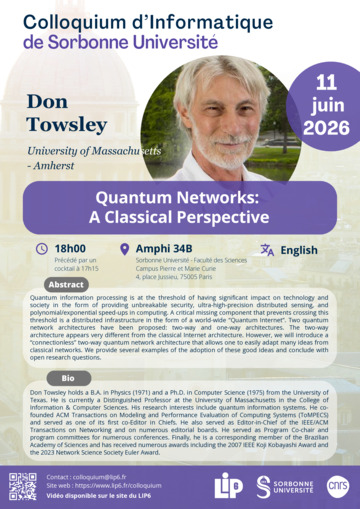 Don Towsley
June 11, 2026
Quantum Networks: A Classical Perspective -
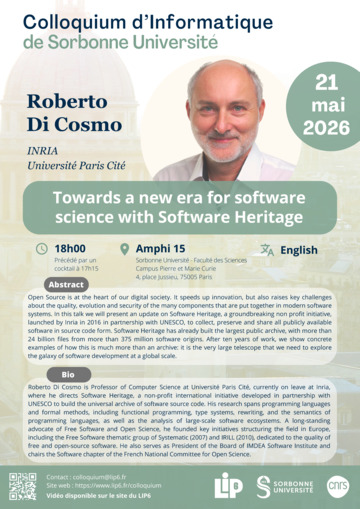 Roberto Di Cosmo
May 21, 2026
Towards a new era for Software Science with Software Heritage -
 Christine Azevedo
January 20, 2026
Restaurer des fonctions de membres paralysés par stimulation électrique -
 Joseph Halpern
December 11, 2025
Actual Causality: A Survey -
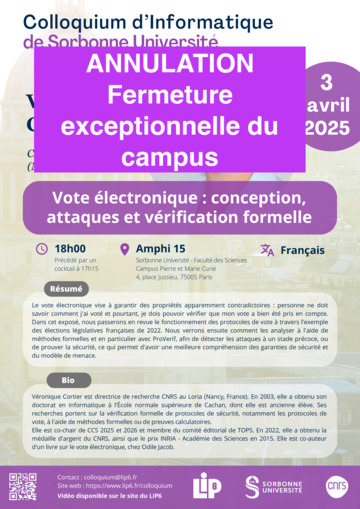 Véronique Cortier
November 26, 2025
Vote électronique : conception, attaques et vérification formelle
-
- Year 2024 – 2025
-
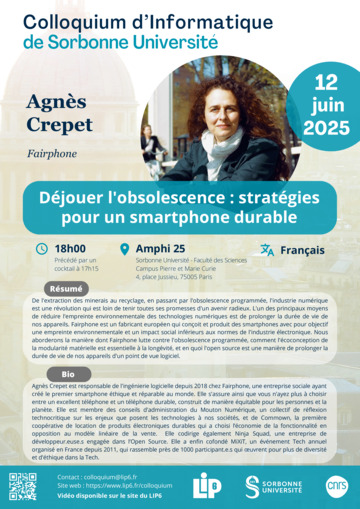 Agnès Crepet
June 12, 2025
Déjouer l'obsolescence : stratégies pour un smartphone durable -
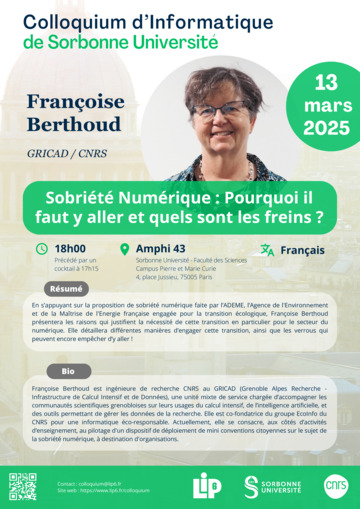 Françoise Berthoud
March 13, 2025
Sobriété Numérique : Pourquoi il faut y aller et quels sont les freins ? -
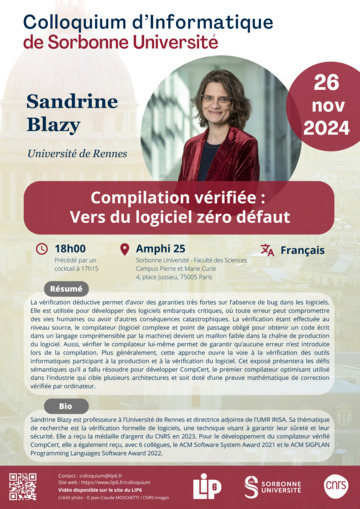 Sandrine Blazy
November 26, 2024
Compilation vérifiée : vers du logiciel zéro défaut -
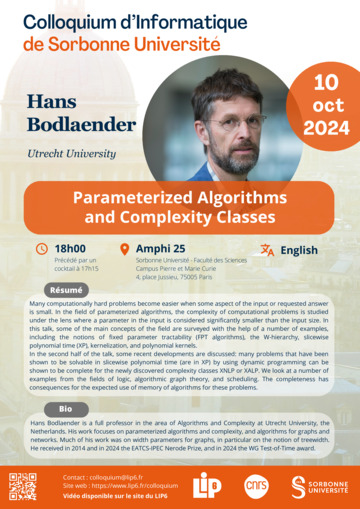 Hans Bodlaender
October 10, 2024
Parameterized Algorithms and Complexity Classes
-
- Year 2023 – 2024
-
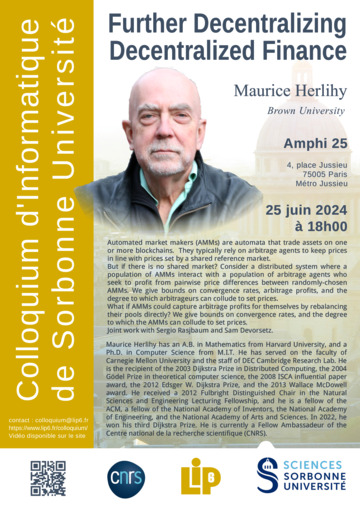 Maurice Herlihy
June 25, 2024
Further Decentralizing Decentralized Finance -
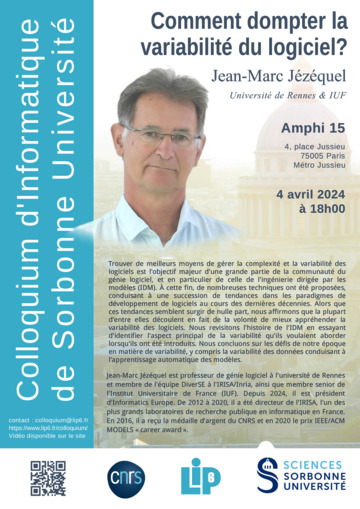 Jean-Marc Jézéquel
April 04, 2024
Comment dompter la variabilité du logiciel ? -
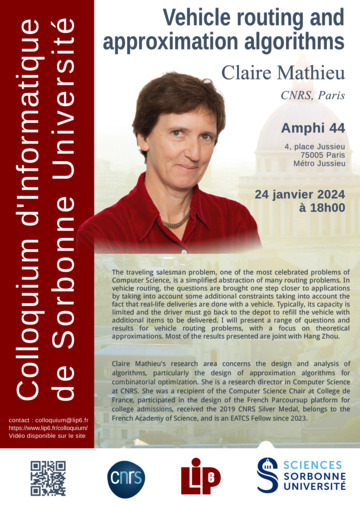 Claire Mathieu
January 24, 2024
Vehicle routing and approximation algorithms -
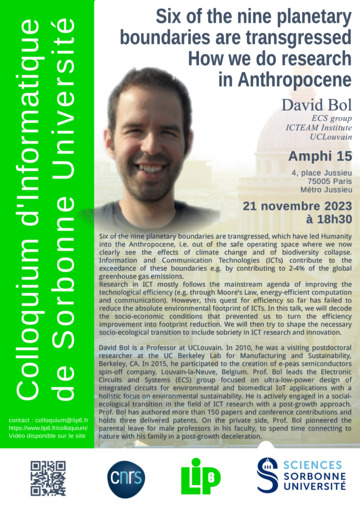 David Bol
November 21, 2023
Six of the nine planetary boundaries are transgressed – How we do research in the Anthropocene?
-
- Year 2022 – 2023
- Year 2021 – 2022
- Year 2020 – 2021
- Year 2019 – 2020
- Year 2018 – 2019
-
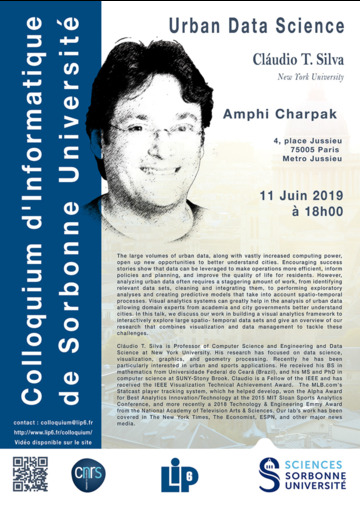 Cláudio T. Silva
June 11, 2019
Urban Data Science -
 Sébastiano Vigna
May 06, 2019
Four degrees of separation (and how we did it) -
 Hugo Gimbert
March 19, 2019
Les algorithmes de Parcoursup -
 Julie Grollier
February 05, 2019
Nanodevices for Bio-inspired Computing -
 Jacques Pitrat
November 20, 2018
L'IA forte -
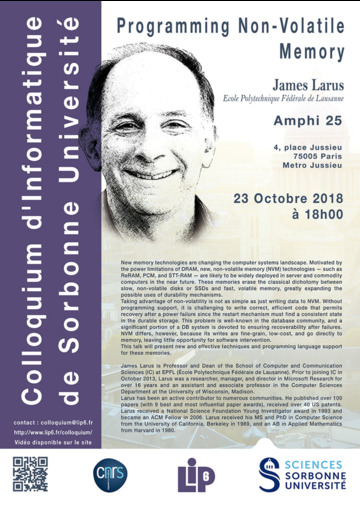 James Larus
October 23, 2018
Programming Non-Volatile Memory
-
- Year 2017 – 2018
-
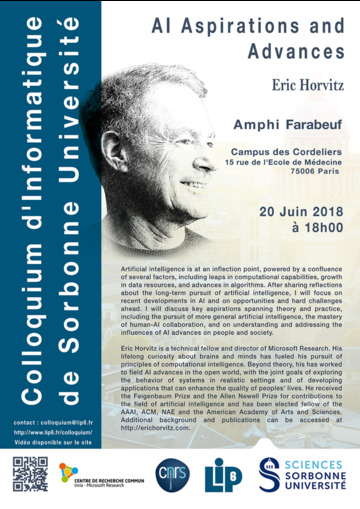 Eric Horvitz
June 20, 2018
AI Aspirations and Advances -
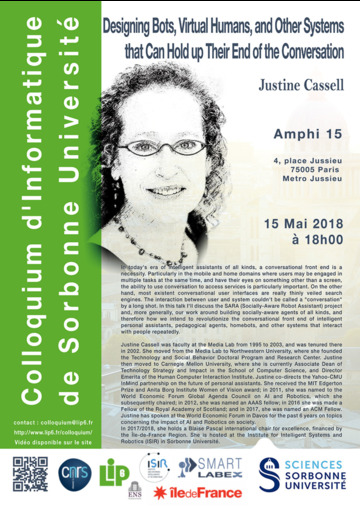 Justine Cassell
May 15, 2018
Designing Bots, Virtual Humans, and Other Systems that Can Hold up Their End of the Conversation -
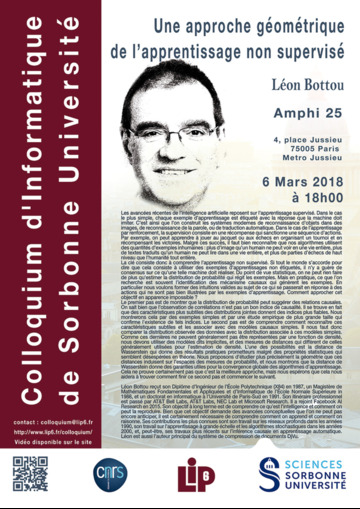 Léon Bottou
March 06, 2018
Une approche géométrique de l'apprentissage non supervisé -
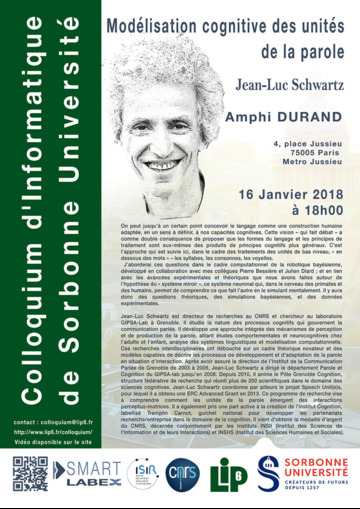 Jean-Luc Schwartz
January 16, 2018
Modélisation cognitive des unités de la parole -
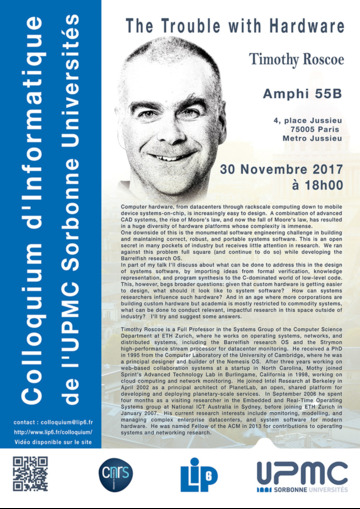 Timothy Roscoe
November 30, 2017
The Trouble with Hardware
-
- Year 2016 – 2017
-
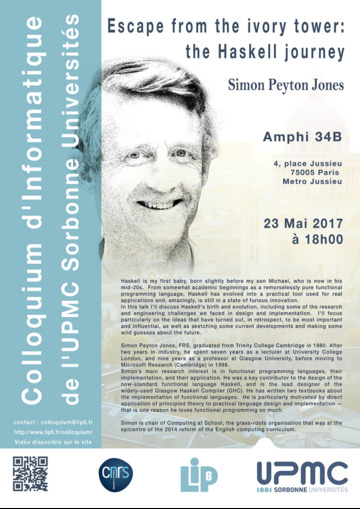 Simon Peyton Jones
May 23, 2017
Escape from the ivory tower: the Haskell journey -
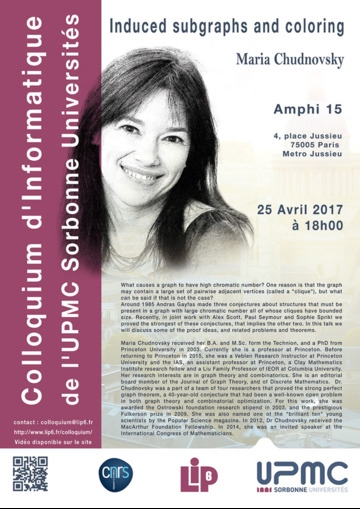 Maria Chudnovsky
April 25, 2017
Induced subgraphs and coloring -
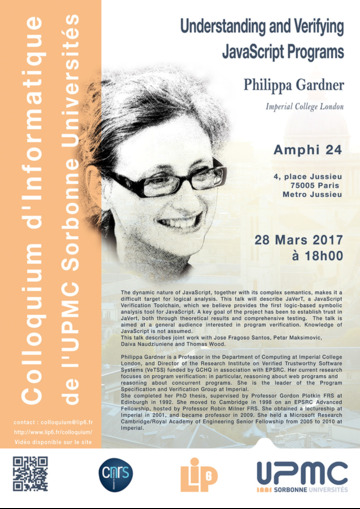 Philippa Gardner
March 28, 2017
Understanding and Verifying JavaScript Programs -
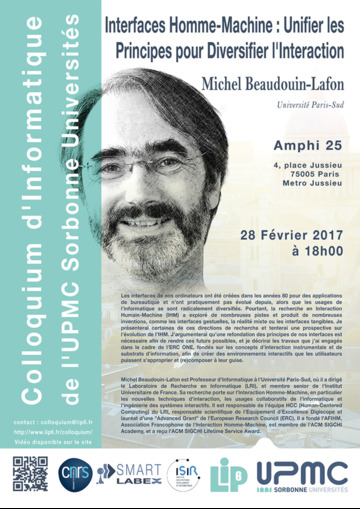 Michel Beaudoin-Lafon
February 28, 2017
Interfaces Homme-Machine -
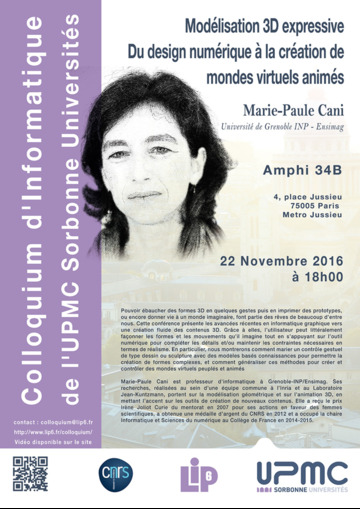 Marie-Paule Cani
November 22, 2016
Modélisation 3D expressive -
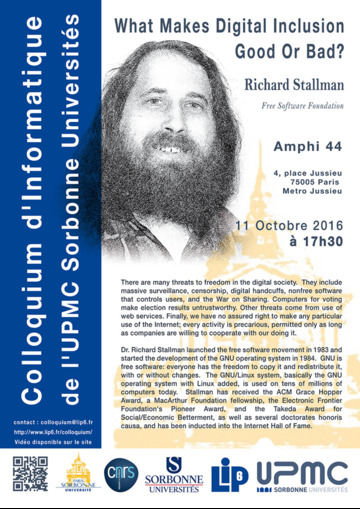 Richard Stallman
October 11, 2016
What Makes Digital Inclusion Good Or Bad? -
Patrick Cousot
September 29, 2016
Abstract interpretation
-
- Year 2015 – 2016
-
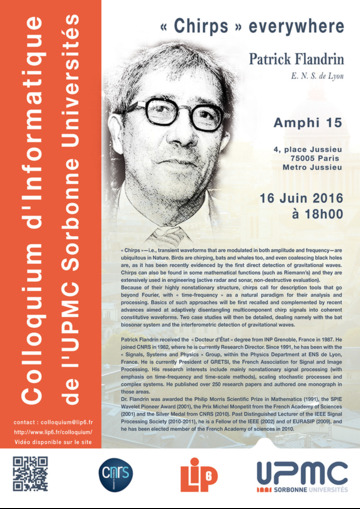 Patrick Flandrin
June 16, 2016
« Chirps » everywhere -
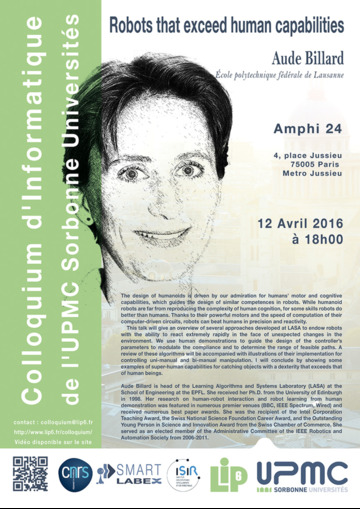 Aude Billard
April 12, 2016
Robots that exceed human capabilities -
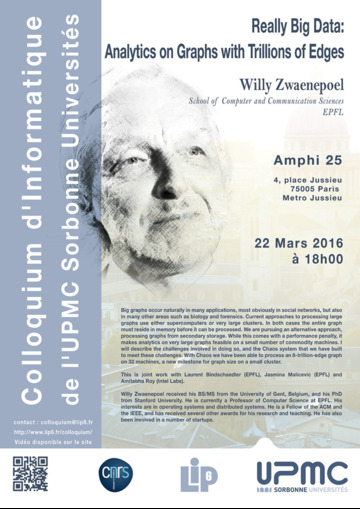 Willy Zwaenepoel
March 22, 2016
Really Big Data -
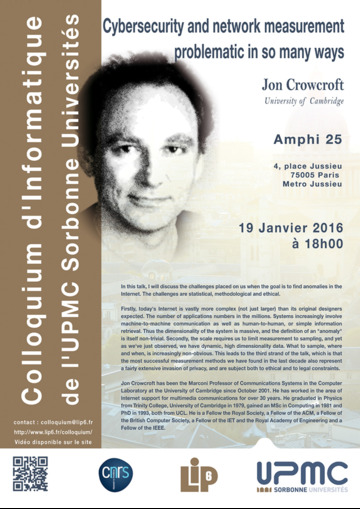 Jon Crowcroft
January 19, 2016
Cybersecurity and network measurement -
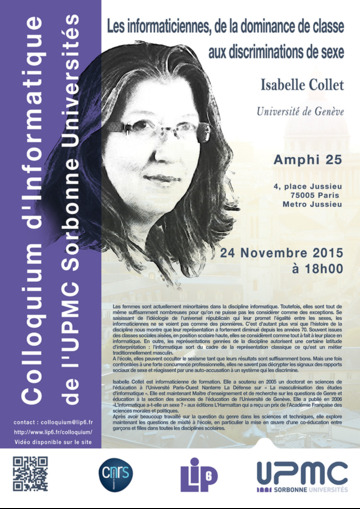 Isabelle Collet
November 24, 2015
Les informaticiennes, de la dominance de classe aux discriminations de sexe -
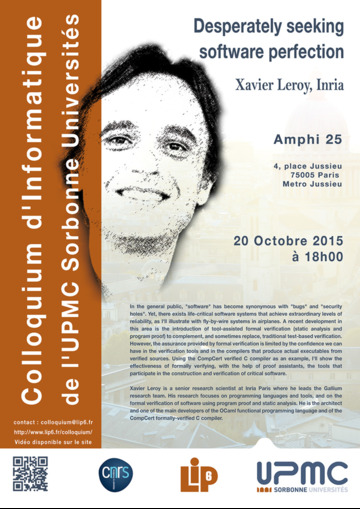 Xavier Leroy
October 20, 2015
Desperately seeking software perfection
-
- Year 2014 – 2015
-
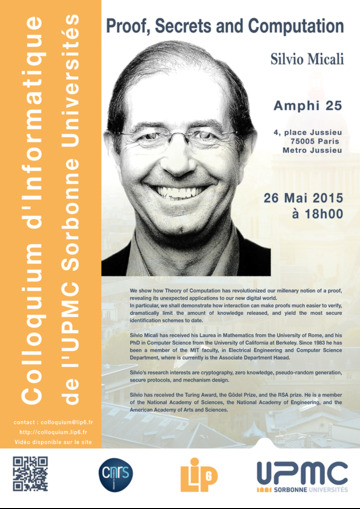 Silvio Micali
May 26, 2015
Proofs, Secrets, and Computation -
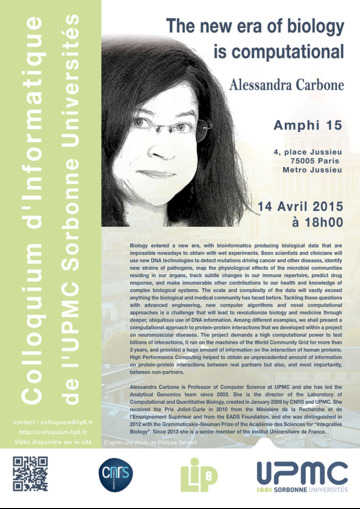 Alessandra Carbone
April 14, 2015
The new era of biology is computational -
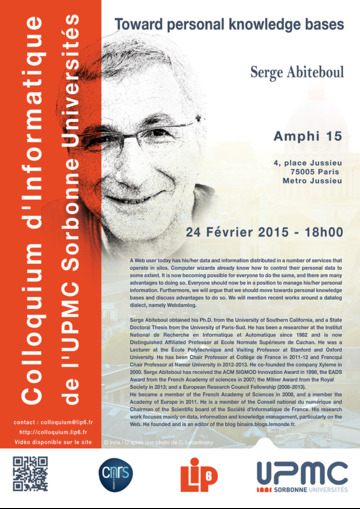 Serge Abiteboul
February 24, 2015
Toward personal knowledge bases -
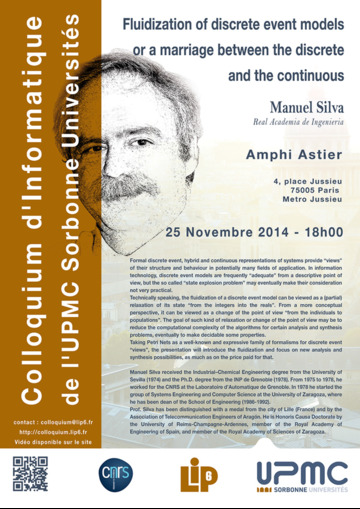 Manuel Silva
November 25, 2014
Fluidization of discrete event models or a marriage between the discrete and the continuous -
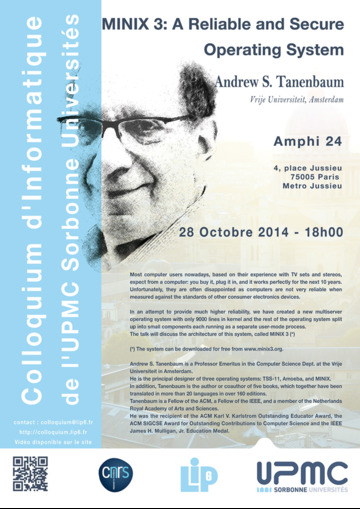 Andrew S. Tanenbaum
October 28, 2014
MINIX 3: A Reliable and Secure Operating System
-
- Year 2013 – 2014
-
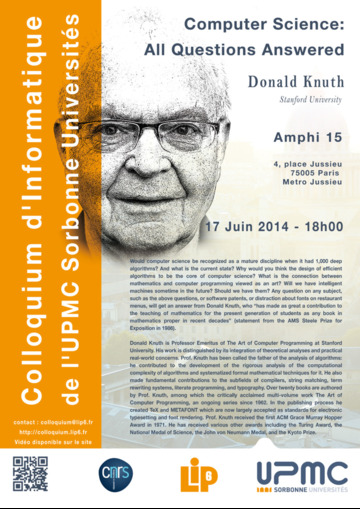 Donald Knuth
June 17, 2014
Computer Science: All Questions Answered -
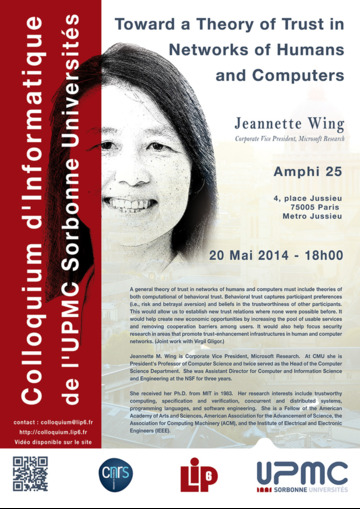 Jeannette Wing
May 20, 2014
Toward a Theory of Trust in Networks of Humans and Computers -
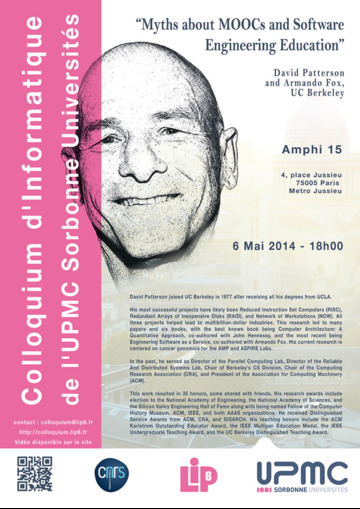 David Patterson
May 06, 2014
Myths about MOOCs and Software Engineering Education -
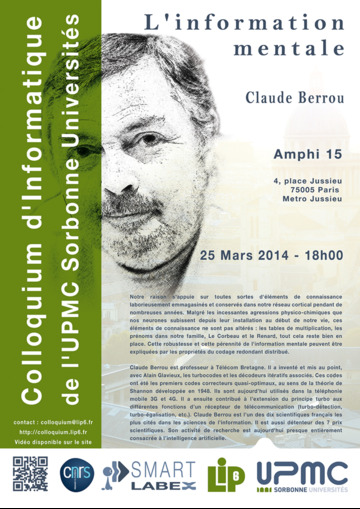 Claude Berrou
March 25, 2014
L'information mentale -
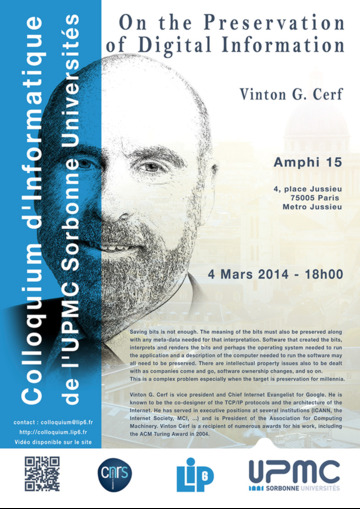 Vint Cerf
March 04, 2014
On the Preservation of Digital Information -
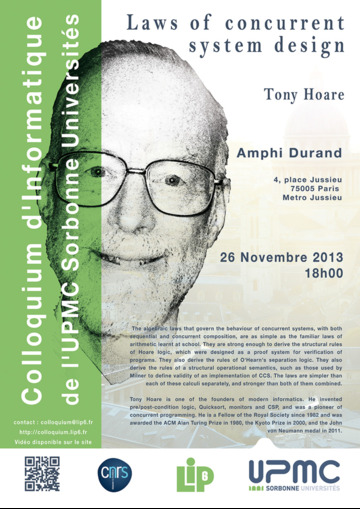 C.A.R. (Tony) Hoare
November 26, 2013
Laws of concurrent system design -
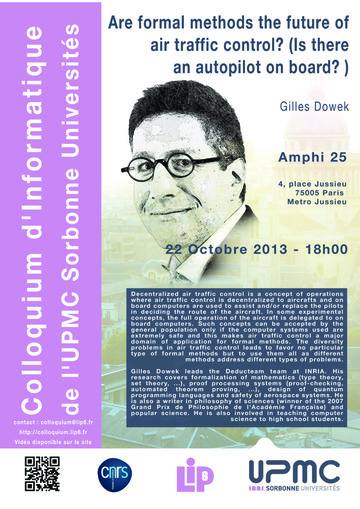 Gilles Dowek
October 22, 2013
Are formal methods the future of air traffic control?
(Is there an autopilot on board?)
-
- Year 2012 – 2013
-
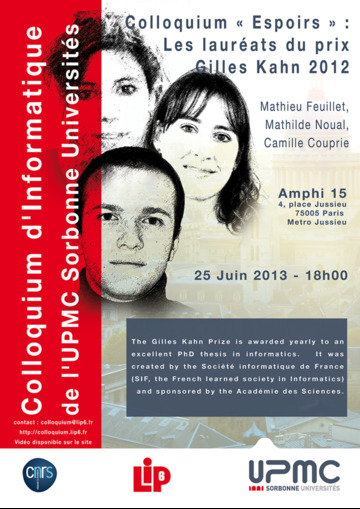 Mathieu Feuillet, Camille Couprie, Mathilde Noual
June 25, 2013
Espoirs : Winners of the 2012 Gilles Kahn prize -
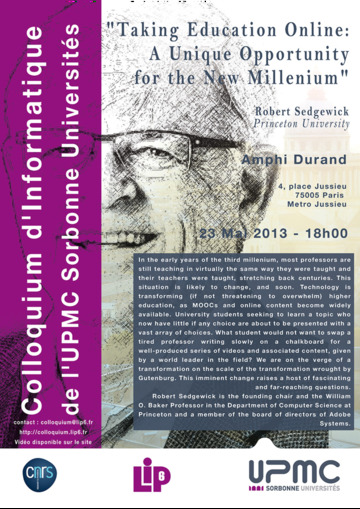 Robert Sedgwick
May 23, 2013
Taking Education Online: A Unique Opportunity for the New Millenium -
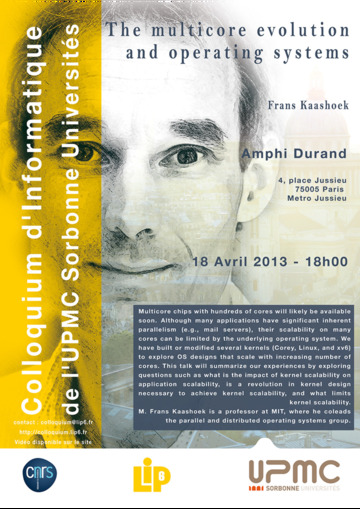 Frans Kaashoek
April 18, 2013
The multicore evolution and operating systems -
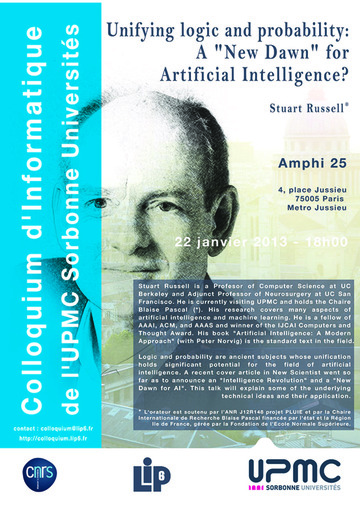 Stuart Russell
January 22, 2013
Unifying logic and probability: A “New Dawn” for Artificial Intelligence? -
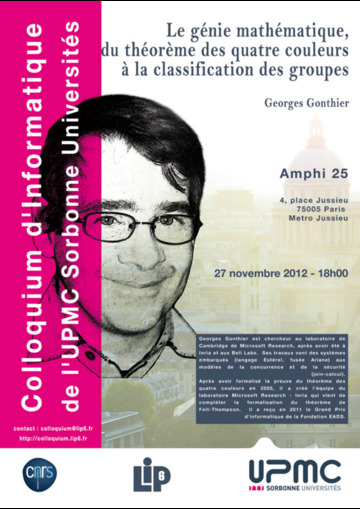 Georges Gonthier
November 27, 2012
Le génie mathématique, du théorème des quatre couleurs à la classification des groupes -
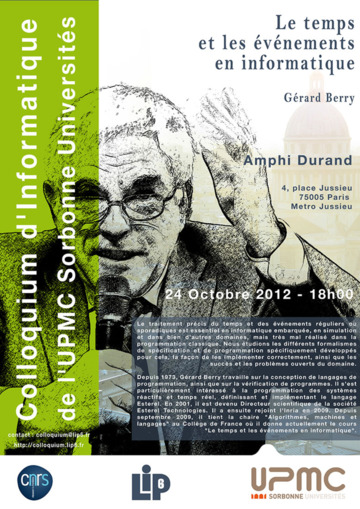 Gérard Berry
October 24, 2012
Le temps et les événements en informatique
-
- Year 2011 – 2012