Projets NPA
Équipe : NPA
Scientific Large-scale Infrastructure for Computing/ Communication Experimental Studies – Implementation Phase
Project Leader : Serge Fdida
01/06/2026

Towards a comprehensive pan-African research infrastructure in Digital Sciences
The African Union's Science, Technology, and Innovation Strategy for Africa (STISA-2024) positions science, technology, and innovation as fundamental drivers of Africa’s socio-economic development and growth. It emphasizes the need to strengthen three main pillars: 1) Building/upgrading Research Infrastructures (RI), 2) Enhancing professional and technical competencies, and 3) Promoting entrepreneurship and innovation. It also highlights the importance of fostering collaboration among African countries and establishing partnerships with international stakeholders. ICT (Information and Communication Technologies) is identified as a critical priority sector. Areas such as computer science, telecommunications, cloud computing, big data, artificial intelligence, machine learning, security, and IoT offer potential for creating new knowledge, research capacities, and industries that address African and global challenges. DIGITAfrica aims to lay the foundations of a pan-African comprehensive RI in Digital Sciences, which will have a transformative impact on AU-EU shared R&I, as well as innovative education and training. DIGITAfrica will prepare the transformation of this partnership into a sustained research initiative in common strategic fields. Drawing from the expertise of partners across five AU countries, each with a strong background and representing diverse African contexts, alongside EU partners who coordinate the first two ESFRI DIGIT RIs dedicated to Digital Sciences, DIGITAfrica aims to exchange experiences, consult stakeholders, and foster dialogue to collaboratively develop a strategic approach. DIGITAfrica will serve as a catalyst for realizing the vision of a pan-African Digital RI and should become a cornerstone of Euro-African cooperation in R&I. The impact of DIGITAfrica will contribute to digitally transforming the African continent for prosperity and inclusivity, and to move with Europe towards a shared twin green and digital transition agenda.
Project Leader : Serge Fdida
01/01/2025
Repousser les Limites Usuelles Concernant l'Avenir des Réseaux Ubiquitaires
Project Leader : Sebastien Tixeuil
01/10/2024

End-to-end Cybersecurity to NEMO meta-OS
Horizon project 101070118 ΝΕΜΟ (Next Generation Meta OS) builds an IoT-Edge-Cloud continuum, in the form of an open-source, flexible, adaptable, and multi-technology meta-Operating System. NEMO aims to unleash the power of Artificial Intelligence IoT to increase European autonomy in data processing and lower CO2 footprint. Leveraging on consortium partners technological excellence, along with clear business and exploitation strategies, CyberNEMO builds on top of NEMO to add end-to-end cybersecurity and trust on IoT-Edge-Cloud-Data Computing Continuum. CyberNEMO will establish itself as a paradigm-shift to support resilience, risk preparedness, awareness, detection and mitigation within Critical Infrastructures deployments and across supply chains. To achieve technology maturity and massive adoption, CyberNEMO will not “reinvent the wheel”, but leverage on existing by-design, by-innovation, and by-collaboration zero-trust cybersecurity and privacy protection systems, and introduce novel concepts, methods, tools, testing facilities and engagement campaigns to go beyond today’s state of the art and create sustainable innovation, already evident within the project lifetime. CyberNEMO will offer end-to-end and full stack protection, ranging from a low level Zero-Trust Network Access layer up to a human AI explainable Situation Perception, Comprehension & Protection (SPCP) framework and tools, collaborative micro-cervices Auditing, Certification & Accreditation and a pan-European Knowledge Sharing, risk Assessment, threat Analysis and incidents Mitigation (SAAM) collaborative platform. Validation and penetration testing will take place in 6 pilots including OneLab for integration, various Critical Infrastructures (Energy, Water, Healthcare), media distribution, agrifood and fintech supply chain, along with their cross- domain, cross-border federation. Sustainability and adoption will be offered via the de-facto European Open source Eclipse Foundation ecosystem.
Project Leader :
02/09/2024
Greener Future Digital Research Infrastructures
GreenDIGIT tackles the challenge of reducing environmental impact of digital research infrastructures (RIs), which account for a growing share of global greenhouse gas emissions due to their high energy consumption. As research becomes increasingly data-intensive, ensuring that digital infrastructures operate sustainably is essential to align with the European Green Deal and UN SDGs. GreenDIGIT responds to this challenge by developing an integrated framework that will enhance the sustainability of digital RIs throughout their entire lifecycle. GreenDIGIT focuses on three major areas: technology innovation, strategic policy development, and capacity building. It established a reference architecture for sustainable RIs, and developing new tools for monitoring, assessing, and optimizing energy efficiency, and minimizing carbon footprints in data centres, cloud infrastructures, and networking components. These solutions will be deployed across four major European digital RIs—EGI, SLICES, SoBigData, and EBRAINS—modelling the entire ESFRI research landscape. GreenDIGIT also prioritizes scientific workflow optimization, integrating Reproducibility as a Service (RaaS) to help researchers design energy-conscious digital applications while ensuring data and experiment reproducibility. Additionally, it will provide policy recommendations, and potential binding-pathway mechanisms to guide RIs toward sustainable operations, along with training programs and a certification framework to equip RIs with the skills for energy-efficient digital services management. Through this approach, GreenDIGIT will not only improve the environmental footprint of participating RIs but also establish scalable best practices for digital RIs across Europe.
Project Leader : Serge Fdida
01/03/2024
SUstainable federation of Research Infrastructures for Scaling-up Experimentation in 6G
6G is expected to emerge as key enabler for the intelligent digital society of 2030 and beyond, providing superior performance via groundbreaking access technologies, such as joint communication and sensing, cell-free, Radio Intelligent Surfaces, and ubiquitous wireless intelligence . Most importantly, 6G is expected to trigger a total rethink of network architecture design, which builds on the key idea of new stakeholders entering into the value chain of future networks. The SUNRISE-6G approach is inspired by the “network of networks” concept of 6G Networks, aiming to integrate all private and public infrastructures under a massively scalable internet-like architecture. SUNRISE-6G similarly aspires to create a federation of 6G test infrastructures in a pan-european facility that will support converged Testing as a Service (TaaS) workflows and tools, a unified catalogue of 6G enablers publicly accessible by experimenters, and cross-domain vertical application onboarding. Experimentation and vertical application onboarding are offered via a Tenant Web Portal, that acts as a single-entry point to the facility, serving end users (e.g., experimenters) and tenants (e.g., vertical developers, infrastructure owners, 6G component manufactures). The project execution is based on 4 pillars, delivering: (a) the Implementation of new 6G enablers, complementary to existing ones being developed in SNS Phase 1 projects, (b) A truly scalable and 3GPP compliant Federation solution that provides access to heterogeneous resources and devices from all Europe, (c) A Federated AI plane aligned with AIaaS and MLOPS paradigms, which promotes a collaborative approach to AI research which benefits immensely from scaling-up datasets and models and (d) a commonly adopted Experimentation Plane, which offers common workflows to experimenters.
Project Leader : Serge Fdida
01/01/2024
6G Trans-Continental Edge Learning
Artificial Intelligence (AI) is widely studied and finding increasing adoption across communication technologies spanning network layers and business ecosystems. It is anticipated to play a central role in the design and operation of future 6G networks. Despite the promise of AI, there remain many obstacles to its use in communication networks. The introduction of software defined elements such as radio access network (RAN) intelligent controllers (RIC) enables multi-party applications for the control and management of networks. However, AI functions are still nascent and such structures do not extend to optical networks or multi-controller environments. 6G-XCEL seeks to address these challenges through research on high edge network use cases that employ multi-party AI controls running over compute accelerators to coordinate control across radio and optical networks. It will develop a reference framework for AI in 6G that will pave the way towards global validation, adoption and standardisation of AI approaches. This framework will enable decentralised AI-based network controls across network domains and physical layers, while promoting security and sustainable implementations. Using the latest AI algorithms and data compression, research on the resulting decentralised multi-party, multi-network AI (DMMAI) framework will enable the development of reference use cases, data and model repositories, curated training and evaluation data, as well as technologies for its use as a benchmarking platform for future AI/ML solutions for 6G networks. 6G-XCEL will bring together a large ecosystem of researchers from the EU and US to implement elements of the DMMAI framework in their testbeds and labs, integrating it into their research programs and validating the framework across platforms. Working with standardisation groups within each jurisdiction, 6G-XCEL will achieve joint progress towards large scale application of AI in 6G networks.
Project Leader : Serge Fdida
01/01/2024
Tester et évaluer une architecture pour la 6G composée de noeuds métamorphiques pour aboutir à la réalisation d'un prototype
Project Leader : Anne Fladenmuller
13/06/2023
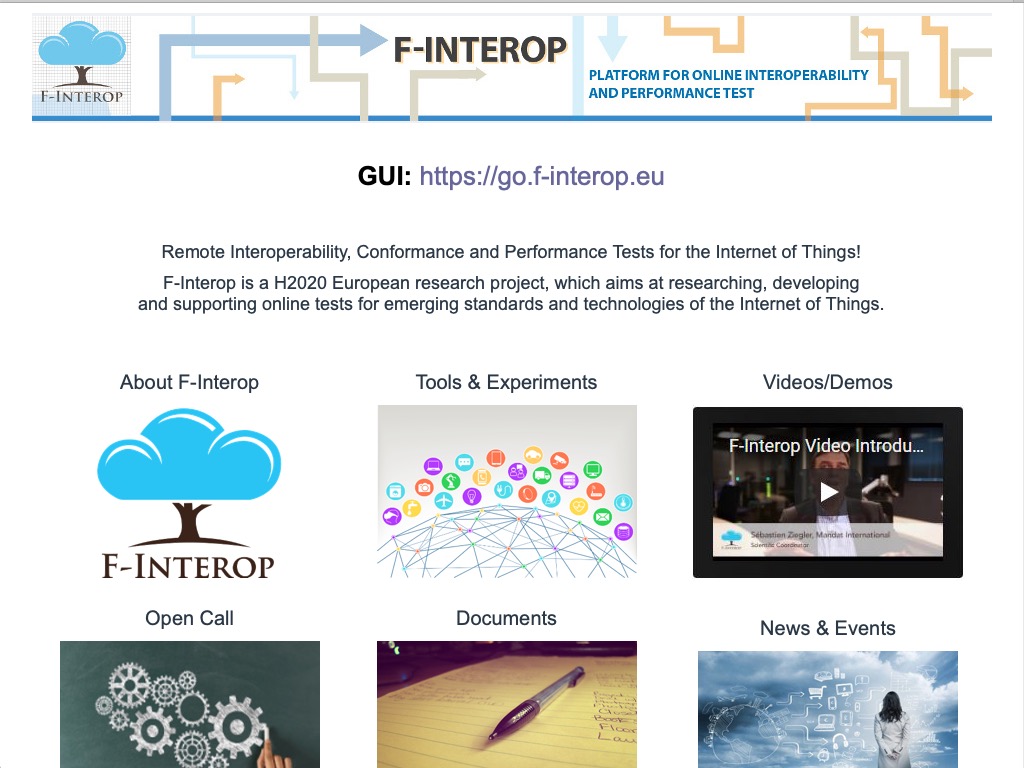
F-Interop - Services de tests d'interopérabilité à distance pour les objets connectés (IoT)
Services de tests d'interopérabilité à distance pour les objets connectés (IoT)
Project Leader : Serge FDIDA
01/01/2016