À la rencontre de... Sriram Gopalakrishnan
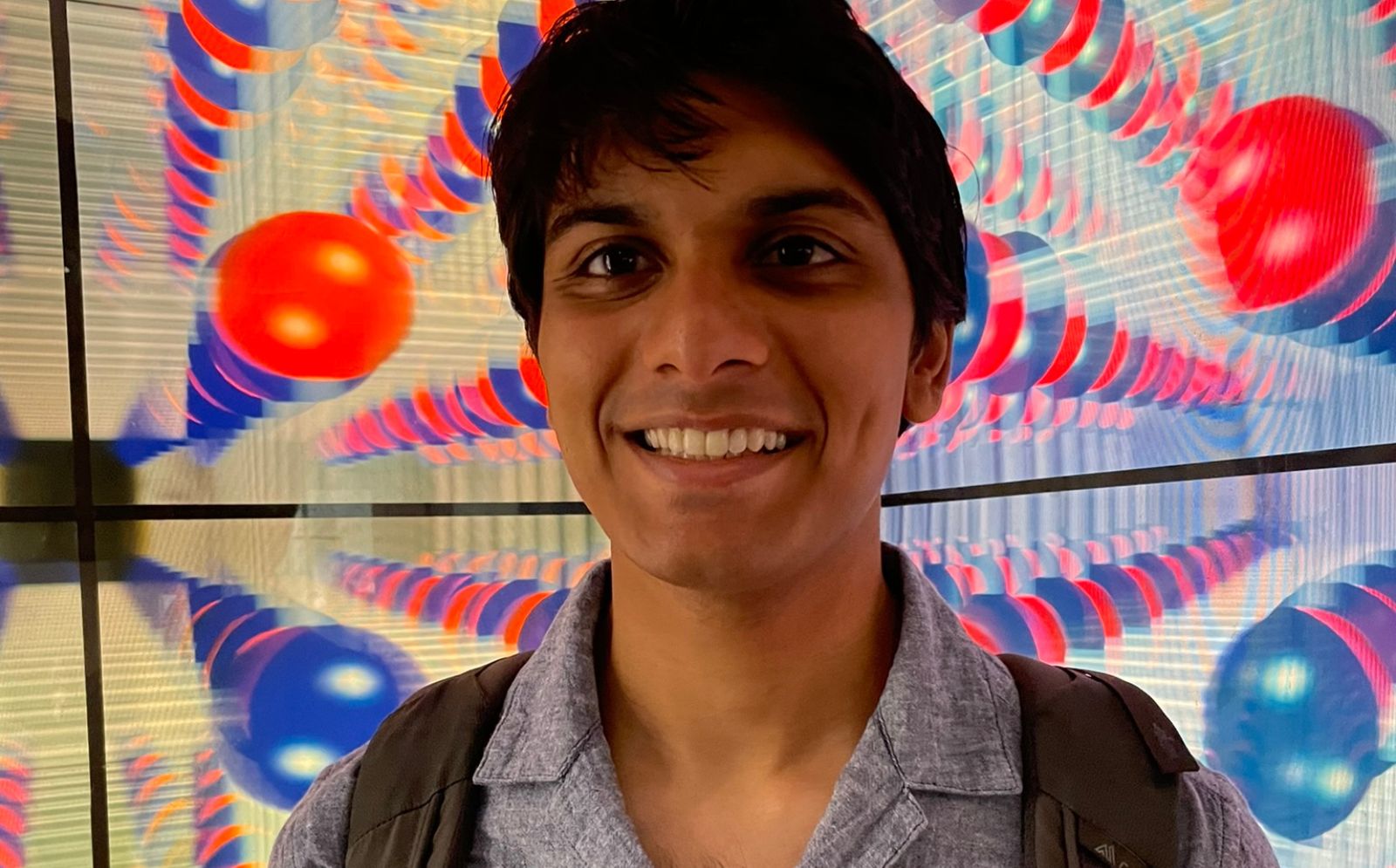
A final-year PhD student in the PolSys team, Sriram Gopalakrishnan works at the intersection of mathematics and computer science, studying complex systems of equations to improve the efficiency of symbolic computation algorithms used in real-world applications.
Q. Where do you come from, and where are you going?
My name is Sriram Gopalakrishnan. I am from Boise, Idaho in the United States. After a bachelor's degree in mathematics from the University of Utah, I started an integrated master's degree through Universiteit Leiden (in the Netherlands) and Université de Bordeaux. My master's thesis led me to start a Ph.D. in 2022 under the supervision of Mohab Safey El Din and Vincent Neiger, on the PolSys team at LIP6.
My Ph.D. is a cotutelle with the University of Waterloo, where I am advised by Éric Schost, and where I currently work in the Symbolic Computation Group. I have about one year left in my program. After my Ph.D., I hope to undertake a postdoc and eventually find a job in academia.
Q. What are you currently working on?
Currently, I like to think about the effective algebraic geometry of determinantal varieties. Algebraic geometry is the study of systems of polynomial equations (algebra) and the points where they all simultaneously vanish (geometry). Determinantal varieties are common vanishing sets of minors of a matrix of polynomials. These objects are highly structured, and show up in a wide range of both theoretical and applied mathematics. At the moment, I am interested in understanding the bit sizes of solutions to determinantal polynomial systems defined over the rational numbers. Bounds on these bit sizes would give new insight into the performance and efficiency of algorithms (such as Gröbner basis algorithms) which solve such polynomial systems.
Q. What does a typical week look like for you?
These days, my time is split up mostly between research and teaching. My current research has required me to learn about a wonderful area of mathematics called arithmetic intersection theory. The time I spend on research usually involves picking apart some specific theorems in papers that I hope will help me tackle the problems I'm working on, meeting with my advisors to work on those problems together and, on the off chance that I've succeeded in proving something interesting, writing it down. At the University of Waterloo, I'm also a teaching/instructional assistant for at least one undergraduate course per term. Each week, this involves holding office hours, leading tutorials, and helping out with course administration.
Q. What do you hope to accomplish during your time at LIP6?
I hope that my time at LIP6 will lead to new contributions at the intersection of symbolic computation and algebraic geometry. In the past few years of my Ph.D., I have had the opportunity to learn about and contribute to algorithms at the forefront of symbolic computation, and I hope that the final year of my Ph.D. will bring new and interesting results. Outside of research, my time at LIP6 has given me the ability to work on my French, which has been a wonderful opportunity.
Q. What is one thing people often misunderstand about your topic?
Many of the problems encountered in symbolic computation are computationally difficult to solve. There are proven results that show that the worst-case performance of some of the state-of-the-art algorithms we use to solve these problems is quite bad. I think this can discourage people from seeing these algorithms as useful tools to tackle the problems that they are interested in. Frequently, the problems that we encounter in applications are so structured that the algorithms developed by researchers in symbolic computation can be highly effective.
Q. What excites you the most about your research?
My research lets me apply deep and interesting mathematics to develop algorithms that could be used to solve real-world, practical problems. In a similar vein, the computational nature of the problems I like to think about lends itself well to implementation and experimentation on a computer. I find this mixture of mathematics and computer science extremely exciting.
Q. Anything else you’d like to add?
Nope!
Contact : Sriram Gopalakrishnan